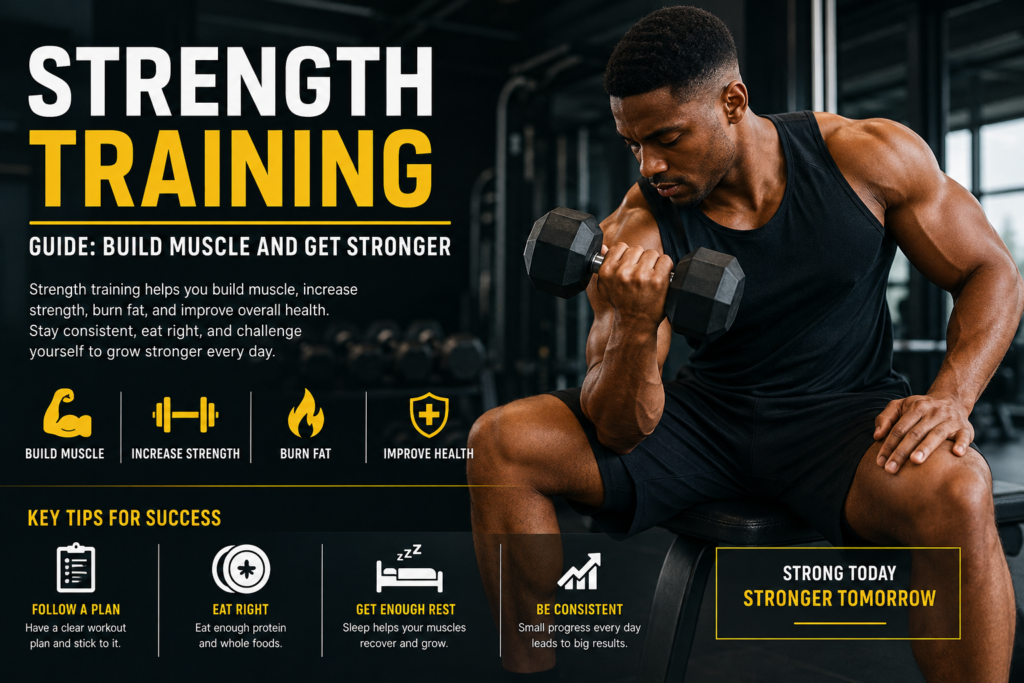
Strength training is one of the most effective ways to build muscle, increase strength, improve fitness, and support overall health. You do not need to spend hours in the gym to see results. With the right exercises, proper nutrition, and consistent training, you can gradually become stronger and build a healthier body.
This Strength Training Guide explains the basics of strength training, the best exercises for beginners, how often to train, what to eat, and how to recover properly.
What Is Strength Training?
Strength training is a type of exercise that makes your muscles work against resistance. The resistance can come from dumbbells, barbells, resistance bands, machines, or even your own body weight.
The goal is to challenge your muscles so they gradually adapt and become stronger.
Common types of strength training include:
- Bodyweight exercises
- Free-weight exercises
- Resistance band workouts
- Weight machines
- Functional strength exercises
Benefits of Strength Training
Adding strength training to your fitness routine can provide several benefits.
1. Builds Muscle
Regular resistance training stimulates muscle growth. When combined with enough protein, calories, and recovery, it can help you develop stronger and more defined muscles.
2. Increases Strength
Strength training helps your muscles become more efficient at producing force. Over time, exercises that once felt difficult can become easier.
3. Supports Healthy Weight Management
Building muscle can increase your body’s energy needs. Strength training can also help you maintain muscle while losing body fat.
4. Improves Bone Strength
Resistance exercises place healthy stress on your bones, which can help support bone strength and overall physical function.
5. Improves Everyday Movement
Stronger muscles can make everyday activities such as lifting, carrying, climbing stairs, and walking easier.
Best Strength Training Exercises for Beginners
If you are new to strength training, start with basic movements that train multiple muscle groups.
Squats
Squats primarily work the legs and glutes. Keep your chest up, push your hips back, and lower your body while keeping your knees aligned with your feet.
Push-Ups
Push-ups work the chest, shoulders, triceps, and core. Beginners can perform them with their knees on the floor or with their hands elevated on a stable surface.
Rows
Rows strengthen the upper back, shoulders, and arms. You can perform them with dumbbells, resistance bands, or a cable machine.
Lunges
Lunges train the legs and glutes while also challenging your balance and coordination.
Overhead Press
The overhead press primarily targets the shoulders and triceps. Use dumbbells or another appropriate resistance and maintain controlled movement.
Planks
Planks strengthen the core and help improve stability. Keep your body in a straight line and avoid letting your hips drop.
How Often Should You Do Strength Training?
For beginners, 2–3 strength training sessions per week can be a good starting point. Allow your muscles time to recover between challenging workouts.
A simple weekly schedule could look like this:
- Monday: Full-body strength workout
- Tuesday: Rest or light activity
- Wednesday: Full-body strength workout
- Thursday: Rest
- Friday: Full-body strength workout
- Saturday: Light cardio or mobility
- Sunday: Rest
Your ideal schedule depends on your fitness level, goals, recovery, and other activities.
How Many Sets and Repetitions Should You Do?
There is no single repetition range that works for everyone. However, beginners can start with manageable weights and focus on good technique.
A practical starting point is:
- 2–3 sets per exercise
- 8–12 repetitions for many exercises
- Rest between sets as needed
- Increase resistance gradually as you become stronger
The most important thing is to use a resistance level that challenges you while allowing you to maintain proper form.
Progressive Overload: The Key to Getting Stronger
One of the most important principles of strength training is progressive overload.
Progressive overload means gradually increasing the challenge placed on your muscles. You can do this by:
- Increasing the weight
- Performing more repetitions
- Adding another set
- Improving exercise technique
- Increasing training difficulty
- Reducing rest periods when appropriate
You do not need to increase everything at once. Small, consistent improvements can produce significant results over time.
Nutrition for Muscle Growth
Training alone is not enough to maximize muscle growth. Your body needs adequate nutrition to repair and build muscle.
Eat Enough Protein
Protein provides amino acids that your body uses to repair and build muscle tissue. Good protein sources include:
- Eggs
- Chicken
- Fish
- Lean meat
- Milk and yogurt
- Beans and lentils
- Nuts and seeds
Eat a Balanced Diet
Include a variety of foods in your diet, including protein, carbohydrates, healthy fats, fruits, and vegetables.
Carbohydrates can provide energy for workouts, while healthy fats support overall health.
Stay Hydrated
Drink enough water throughout the day, especially before, during, and after exercise.
Recovery Is Part of Training
Your muscles need time to recover after challenging workouts. Recovery allows your body to repair itself and adapt to training.
Important recovery habits include:
- Getting enough sleep
- Taking rest days
- Eating nutritious foods
- Staying hydrated
- Managing training volume
- Using light mobility or stretching when appropriate
Avoid training the same muscle groups intensely every day without adequate recovery.
Common Strength Training Mistakes
Avoid these common mistakes when starting a strength training program:
Using Too Much Weight
Lifting more weight than you can control can reduce exercise quality and increase injury risk. Start with a manageable resistance.
Ignoring Technique
Good form should be a priority. Learn the correct movement before focusing on heavier weights.
Training Without a Plan
Random workouts can make it difficult to track progress. Follow a simple program and record your exercises, sets, repetitions, and weights.
Expecting Immediate Results
Building strength and muscle takes time. Consistency is more important than trying to make dramatic changes in a few weeks.
Neglecting Recovery
More training is not always better. Rest and recovery are essential parts of an effective strength training program.
Simple Beginner Strength Training Workout
Try this full-body routine 2–3 times per week, depending on your fitness level:
| Exercise | Sets | Repetitions |
|---|---|---|
| Squats | 3 | 8–12 |
| Push-Ups | 3 | 8–12 |
| Dumbbell Rows | 3 | 8–12 |
| Lunges | 2 | 8–12 each leg |
| Overhead Press | 2–3 | 8–12 |
| Plank | 2–3 | 20–45 seconds |
Start with a light resistance and focus on controlled movements. As the exercises become easier, gradually increase the challenge.
Final Thoughts
A successful strength training routine does not need to be complicated. Focus on basic exercises, use proper technique, train consistently, eat a balanced diet, and give your body enough time to recover.
Whether your goal is to build muscle, become stronger, improve your fitness, or feel better during everyday activities, strength training can be an important part of your fitness routine.
Start with manageable workouts, track your progress, and gradually increase the challenge. With consistency and patience, you can build strength and make meaningful progress toward your fitness goals.